Wireman
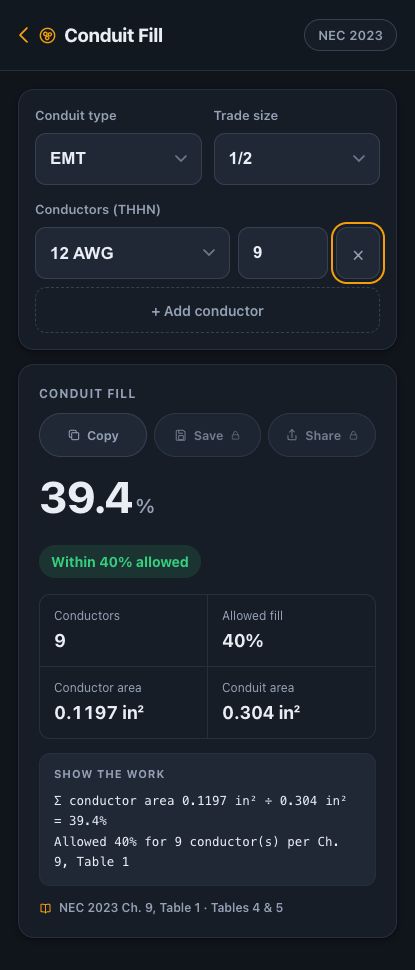
Nine 12 AWG THHN conductors occupy 39.4% of 1/2-inch EMT in Wireman’s model, within the ordinary 40% fill limit for more than two conductors. Ten occupy 43.8% and exceed it. This is a physical fill comparison, not approval of the conductor ampacity or pulling conditions.
Define exactly what is being counted
Use an ordinary raceway run, not a short nipple eligible for a different fill allowance. Assume every wire included in this example has the 12 AWG THHN insulated area used by the calculator. Count all nine physical conductors, including any insulated equipment grounding conductor. Do not confuse this total with the current-carrying conductor count used for ampacity adjustment.
| Conduit type | EMT |
|---|---|
| Trade size | 1/2 inch |
| Conductor size | 12 AWG THHN |
| Conductor count | 9, including any grounds in this example |
Add the areas, then divide
The app uses a 0.0133 in² insulated area for each 12 AWG THHN conductor and 0.304 in² internal area for 1/2-inch EMT. These are the Chapter 9 Table 5 and Table 4 values used for the example. Use insulated area, not the bare copper cross-section or the raceway’s nominal trade-size diameter.
Total conductor area = 9 × 0.0133 = 0.1197 in²
Fill = 0.1197 ÷ 0.304 × 100 ≈ 39.4%
40% area allowance = 0.304 × 0.40 = 0.1216 in²
The result card shows 39.4%, a conductor area of 0.1197 in² and “Within 40% allowed.” The difference from the 40% area allowance is only 0.0019 in²; being close to the fill limit does not establish that a pull will be easy.
Southwire’s Power Cable Installation Guide, conduit-fill section explains the area method and provides EMT dimensions. For the underlying insulated-conductor values and current requirements, consult NEC Chapter 9 Tables 4 and 5 through NFPA 70.
Add one conductor
Changing only the count to ten gives 0.1330 in² of conductor area:
10 × 0.0133 ÷ 0.304 × 100 ≈ 43.8%
Wireman flags the result as over 40%. Reassess the raceway size and the full installation design; do not round 43.8% down or omit a grounding conductor to make the result pass.
Why not always use 40%?
The ordinary Chapter 9 Table 1 percentages depend on how many conductors or cables are present: 53% for one, 31% for two, and 40% for more than two. Southwire summarizes these in its cable-installation best practices. Special cases need their own rules.
Check the remaining design constraints
- Ampacity: determine which conductors count as current-carrying and apply the appropriate adjustment separately.
- Actual products: Wireman uses THHN areas. Other insulation types, cable assemblies and compact conductors can require different data.
- Raceway type: EMT, PVC Schedule 40 and RMC have different internal areas even at the same nominal trade size.
- Pulling conditions: bends, length, pulling tension and manufacturer instructions still matter.
Code basis: NEC 2023 Chapter 9 Tables 1, 4 and 5. This example uses the ordinary fill limits modeled by Wireman and does not cover short-nipple exceptions or every cable and raceway type.
About this example
Original worked example prepared for Wireman. Arithmetic and displayed outputs were checked against the app’s calculation engine on 24 September 2026. This is a product explanation, not an independently certified electrical design or a licensed professional review. Verify your installation against the adopted code, equipment instructions and local amendments.